
← RESEARCH FOCUS
// 01 · RESEARCH AREA

Technology development

We develop methods to prepare samples, separate peptides, and acquire mass spectrometry data, so we can identify and quantify more proteins with greater speed, reproducibility, and consistency.

RECENT HIGHLIGHTS

Three recent papers from the group

01
Nature Communications · 20 March 2024

One-Tip enables comprehensive proteome coverage in minimal cells and single zygotes

Zilu Ye, Pierre Sabatier, Javier Martin-Gonzalez, Akihiro Eguchi, Maico Lechner, Ole Østergaard, Jingsheng Xie, Yuan Guo, Lesley Schultz, Rafaela Truffer, Dorte B. Bekker-Jensen, Nicolai Bache, Jesper V. Olsen

One-Tip combines one-pot sample preparation in a single pipette tip with narrow-window DIA, removing the multi-step processing that causes sample loss. It identifies more than 9,000 proteins from around 1,000 HeLa cells, around 6,000 in single cells from early mouse embryos, and more than 3,000 from just 16 ng of plasma extracellular vesicles.

Read the paper →
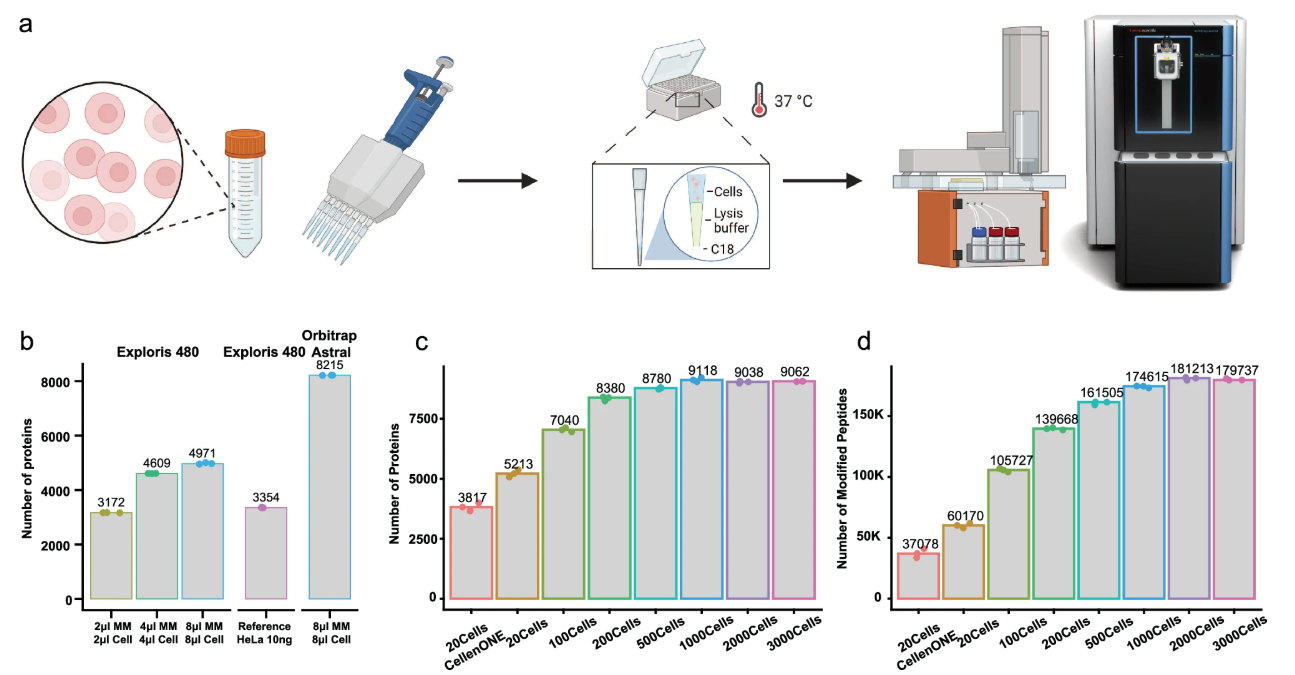
One-Tip workflow and protein identifications across cell inputs, Ye et al. 2024
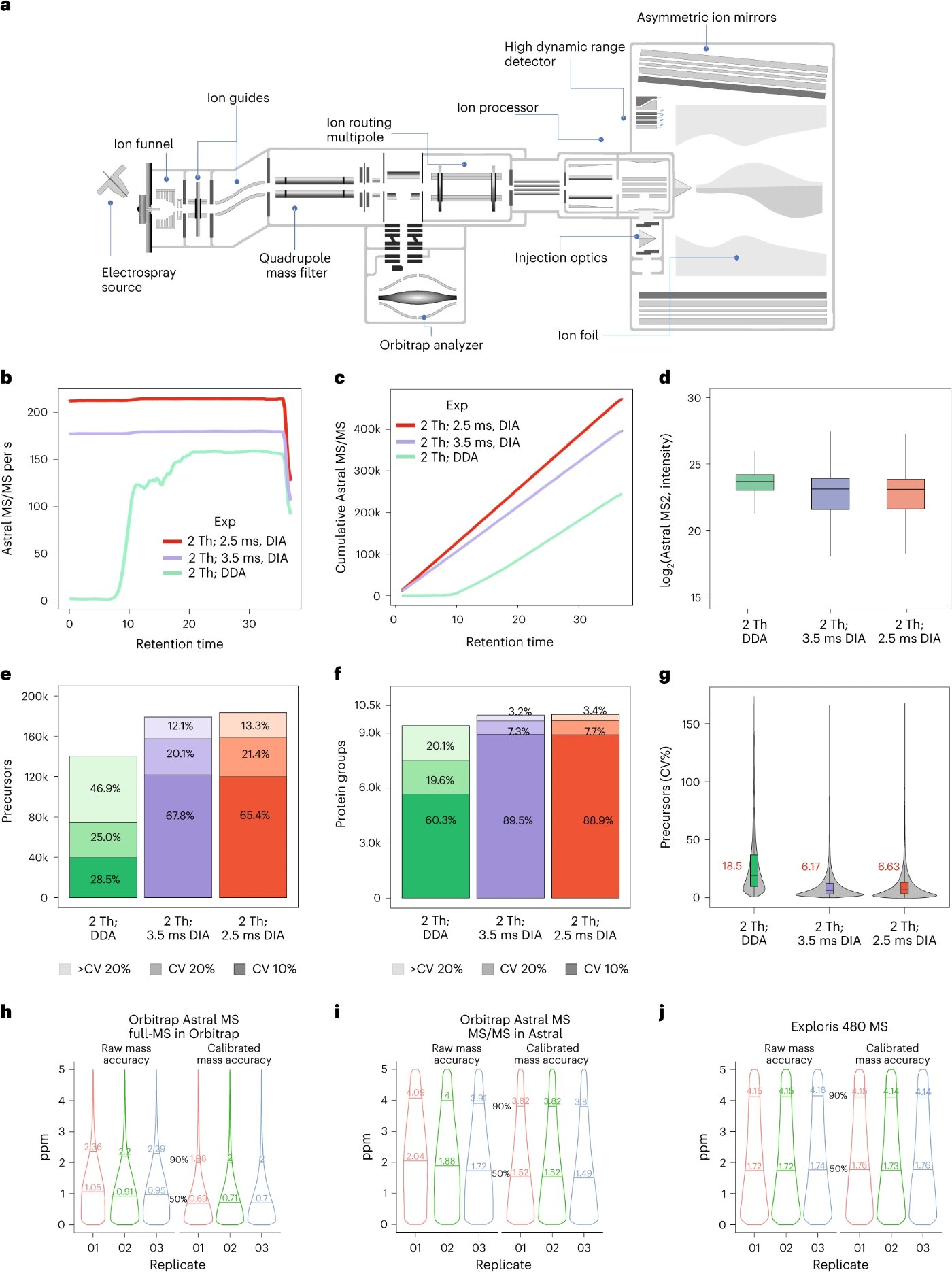
Orbitrap Astral schematic and narrow-window DIA performance, Guzman et al. 2024
02
Nature Biotechnology · January 2024

Ultra-fast label-free quantification and comprehensive proteome coverage with narrow-window data-independent acquisition

Ulises H. Guzman, Ana Martinez-Val, Zilu Ye, Eugen Damoc, Tabiwang N. Arrey, Anna Pashkova, Santosh Renuse, Eduard Denisov, Johannes Petzoldt, Amelia C. Peterson, Florian Harking, Ole Østergaard, Rasmus Rydbirk, Susana Aznar, Hamish Stewart, Yue Xuan, Daniel Hermanson, Stevan Horning, Christian Hock, Alexander Makarov, Vlad Zabrouskov, Jesper V. Olsen

Narrow-window DIA (nDIA) pairs a quadrupole Orbitrap with the Astral analyzer to run MS/MS scans at around 200 Hz with 2-Th windows, closing the gap between data-dependent and data-independent methods. It reaches around 10,000 human protein groups in half an hour, or around 7,000 in five minutes, about three times the coverage of earlier state-of-the-art MS, and quantifies more than 14,000 protein groups in a single 30-minute run.

Read the paper →
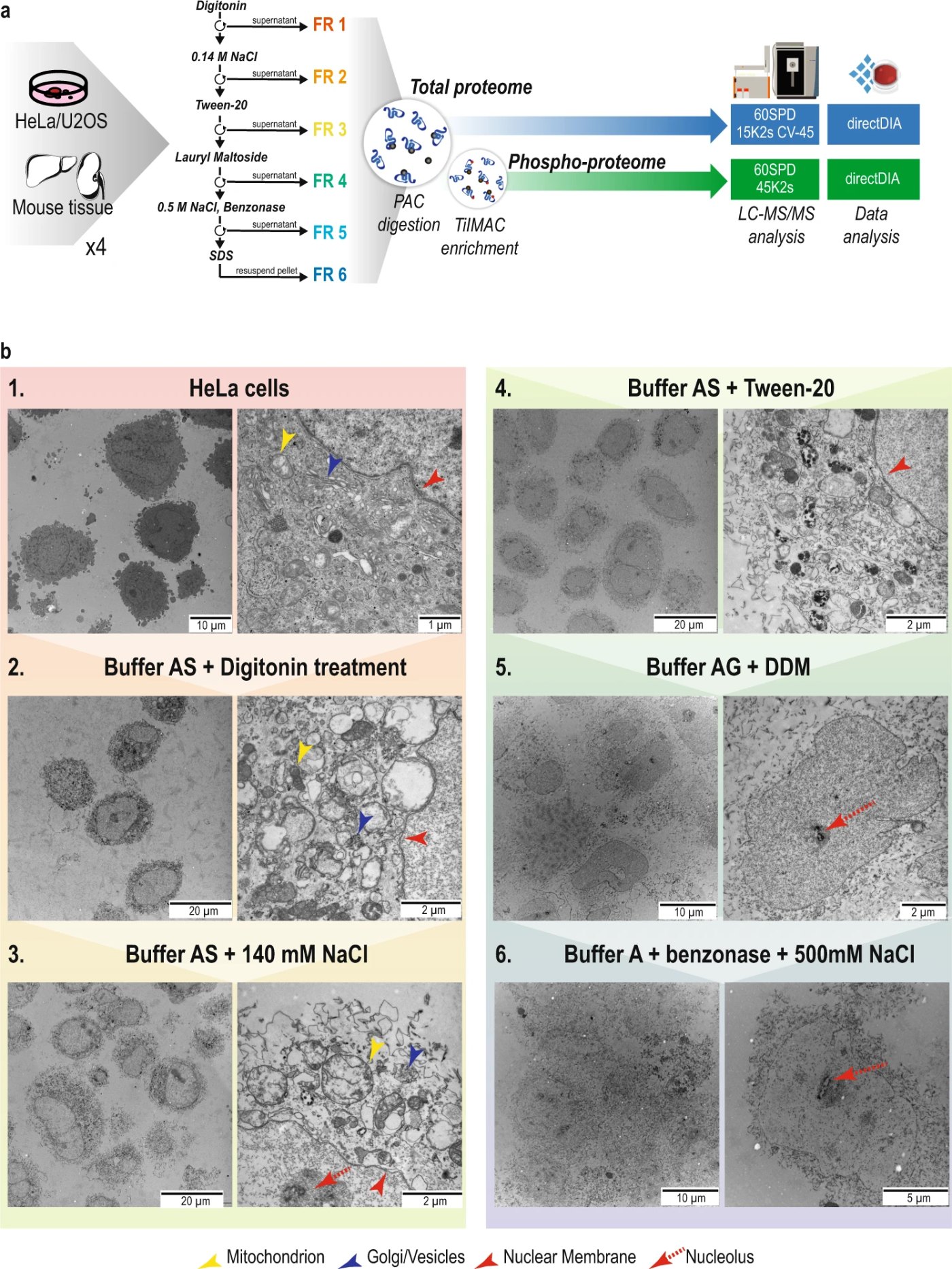
Sequential subcellular fractionation workflow with electron micrographs of each fraction, Martinez-Val et al. 2021
03
Nature Communications · 7 December 2021

Spatial-proteomics reveals phospho-signaling dynamics at subcellular resolution

Ana Martinez-Val, Dorte B. Bekker-Jensen, Sophia Steigerwald, Claire Koenig, Ole Østergaard, Adi Mehta, Trung Tran, Krzysztof Sikorski, Estefanía Torres-Vega, Ewa Kwasniewicz, Sólveig Hlín Brynjólfsdóttir, Lisa B. Frankel, Rasmus Kjøbsted, Nicolai Krogh, Alicia Lundby, Simon Bekker-Jensen, Fridtjof Lund-Johansen, Jesper V. Olsen

A high-throughput workflow based on sequential cell fractionation that profiles the proteome and phosphoproteome across six subcellular fractions. Benchmarked on EGFR signalling in HeLa cells and mouse tissues, it also revealed the relocation of ribosomal proteins in response to hypertonic stress and muscle contraction. The data can be explored at SpatialProteoDynamics.github.io.

Read the paper →